5 Signs Your Manufacturing Business Has Outgrown Excel and Tally
 Admin
Updated
4 min read
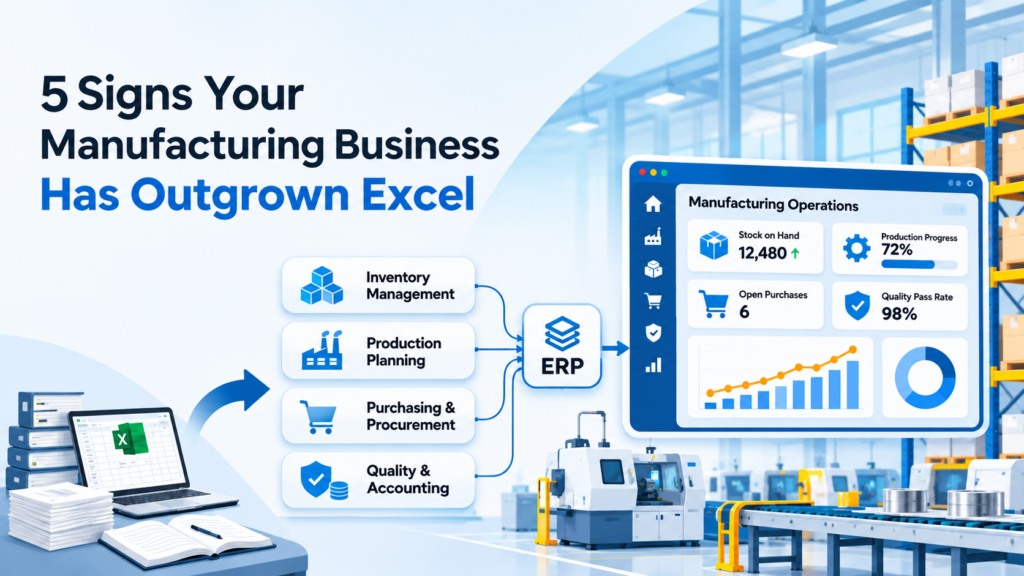
A manufacturing business has outgrown Excel and Tally when it cannot see real-time stock, calculate actual product cost, plan materials against orders, track work in progress or trust its reports without manual reconciliation. At that stage, an ERP connects these processes in one system.
Most Indian manufacturers start with Excel for production and Tally for accounts. It works while order volumes are small and the owner knows every detail personally. As the business grows, spreadsheets multiply, the same data is re-entered across files, and decisions are made on numbers nobody fully trusts. The cost is rarely visible in one place, but it shows up as delayed orders, emergency purchases, margin surprises and long month-end closings.
5 Signs Your Manufacturing Business Needs an ERP
Sign 1: You cannot see real-time stock
Stock figures depend on who last updated the sheet. Purchase does not know what production has consumed, and production does not know what has arrived at the gate. Teams walk to the store to check physically before committing to a customer. When stock is wrong, every downstream decision purchasing, scheduling, delivery promises is wrong too.
Sign 2: You do not know the actual cost of a product
Costing is based on raw-material prices only, or on a sheet prepared months ago. Labour, machine time, power, overheads and scrap are estimated or ignored. Quotations are priced on assumptions, and some products that look profitable are actually sold at a loss. Without actual cost per batch, price increases and product decisions become guesswork.
Sign 3: Material shortages stop production
Orders are accepted without checking whether materials are available, reserved or already on order. Requirements are calculated manually from BOMs kept in Excel. The line stops while purchase rushes to buy at higher prices and pays for express freight. At the same time, other materials pile up because nobody linked purchasing to actual production demand.
Sign 4: Nobody knows the status of an order
Sales calls production, production calls stores, and the customer waits. Work in progress is tracked on whiteboards, registers or WhatsApp groups. Delivery dates are promised without visibility of machine load or material readiness, so commitments slip and customer trust erodes.
Sign 5: Month-end takes days of reconciliation
Accounts reconciles Tally with stock sheets, production registers and dispatch records manually. Differences are adjusted rather than explained. Reports arrive two or three weeks after month-end—too late to influence decisions about pricing, purchasing or production.
Practical example
A Coimbatore pump manufacturer with 60 employees maintains 14 Excel files for orders, BOMs, stock, production and dispatch, with accounts in Tally. A single order change must be updated in four files. Shortages of bearings and castings stop the line twice a month, and month-end closing takes eight working days. None of these are people problems; they are system problems.
What an ERP changes
An ERP connects sales, purchase, inventory, production, quality and accounting in one database. A Sales Order drives the Production Plan, the Production Plan generates material requests and work orders, and production entries update stock and costing automatically. Everyone sees the same numbers, and reports are available when decisions are being made, not weeks later.
How ERPNext helps
ERPNext covers BOMs, Production Plans, Work Orders, Job Cards, inventory, purchasing, quality inspection and GST-ready accounting in one platform, with no per-user licence fee. Manufacturers can start with core modules and expand as they grow, and existing Tally and Excel masters and opening balances can be migrated.
Before you move
Before choosing an ERP, list your current files and registers, the decisions you struggle to make, and the reports you wish you had. Clean your item master and BOMs, because an ERP built on inaccurate data reproduces the same problems faster. A short business-process review helps define the right scope before implementation begins.
Conclusion
If your team spends more time reconciling spreadsheets than running the factory, you have outgrown Excel. An ERP gives manufacturers one reliable source of truth.
See how TechfordAI implements ERPNext for manufacturers and book a free manufacturing process review
FAQs
- When should a manufacturer move from Excel to ERP?
When data is entered in multiple places, stock and costing cannot be trusted, and reports depend on manual reconciliation. Growth in orders, products or employees usually makes this unavoidable. - Can ERPNext replace Tally?
Yes. ERPNext includes GST-compliant accounting, so many manufacturers move accounting to ERPNext. Some keep Tally for a transition period, but running one connected system avoids double entry. - Is ERPNext suitable for small manufacturers?
Yes. ERPNext has no per-user licence fee and can start with core modules inventory, purchase, manufacturing and accounting then expand as the business grows.
Planning an ERPNext implementation?
Share your requirements and our team will help you identify the right modules, timeline and next steps.
